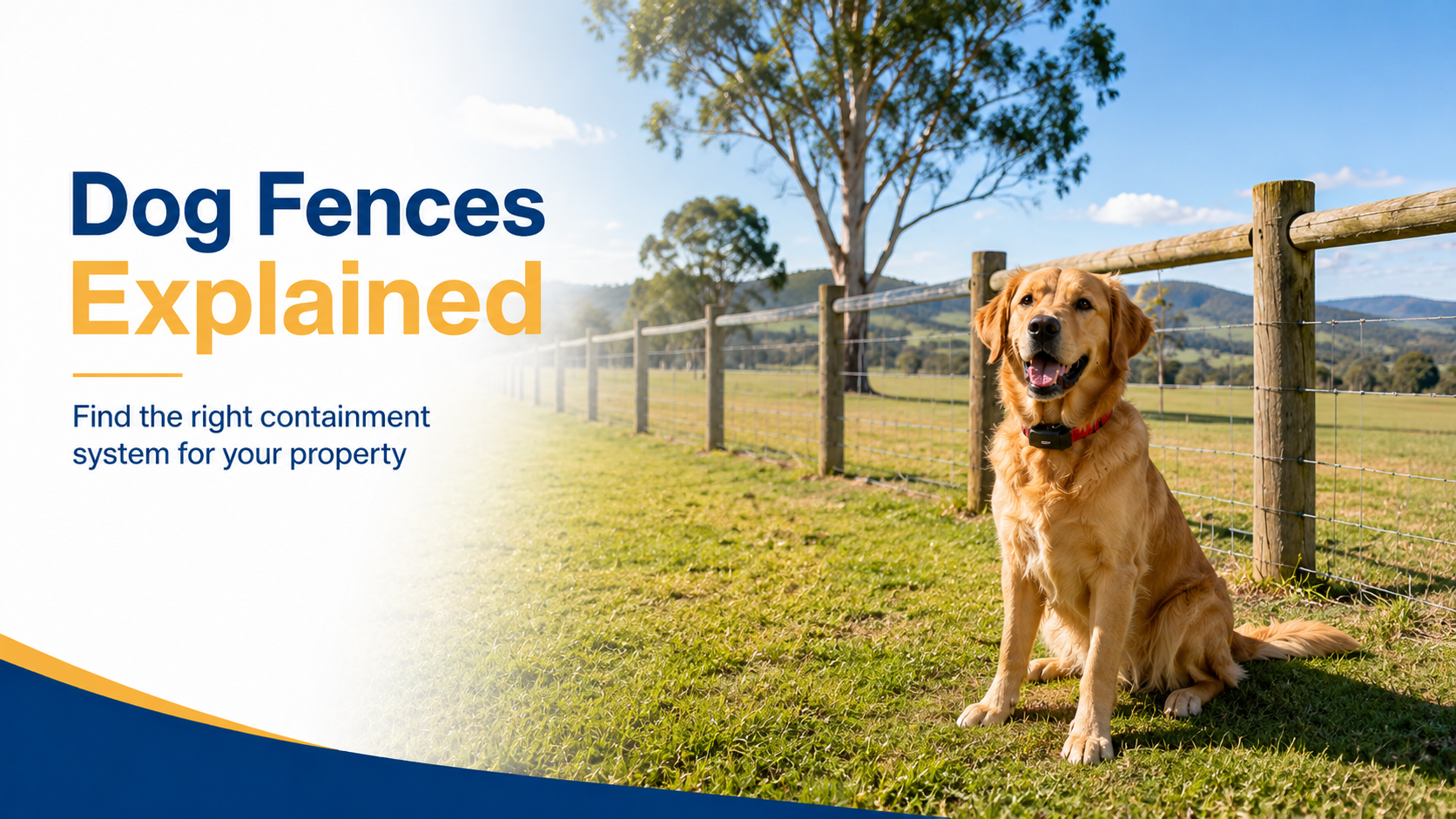
Wired vs Wireless vs GPS Dog Fences: Which System Is Best?
Electric dog fences all aim to do the same job: keep your dog safely contained. The difference is how the boundary is created. Wired fences use a physical boundary wire, wireless fences use a circular signal from a base unit, and GPS fences use satellite positioning.
For most properties, the wired fence is the best option because it creates the most accurate and consistent boundary. Wireless and GPS fences can suit specific situations, but they have more limitations with shape, signal accuracy, collar size and ongoing maintenance.
Best for any dog and situation. Covers any size or shape up to 100 acres, more if required, with the most accurate and consistent boundary.
Quick no-wire setup, but restricted to a circle up to 32m radius. Metal, sheds, cars and other structures can shrink or distort the zone.
Wire-free setup for larger open properties over 3/4 acre. Needs clear sky view, daily charging and is not ideal for exact fenceline control.
The quick answer
If you want the most accurate and consistent containment, a wired dog containment fence is the strongest option. It does take more work upfront because the boundary wire needs to be installed, and large properties may need extra wire, but the result is a clear boundary that follows your actual property layout.
A wired fence can block the dog from reaching the fenceline, driveway or areas like garden beds or waterways, rather than only creating a general zone nearby. This is a major advantage when the boundary is close to a road, neighbour, livestock, dam, driveway or open gate area.
Wireless fences and GPS fences are easier to set up because there is no wire, but they involve more compromise. Wireless fences are limited to a circular area and can be affected by structures inside the circle, especially metal. GPS fences are better suited to large open properties, but they are not as accurate around an exact fenceline, and the collars need daily charging.
How each fence type works
Wired Dog Containment Fences
A wired fence uses a transmitter and boundary wire. The wire can be installed around the property boundary, attached to suitable existing fencing, run across driveways, shaped around gardens, or used to block specific areas such as pools, sheds, front gates and side access points.
- Covers any size or shape up to 100 acres, with larger areas possible if required.
- Creates the most accurate and consistent boundary.
- Can block the dog reaching the fenceline, not just a general area near it.
- Suitable for small yards, suburban homes, large blocks and acreage.
- Collar options can suit dogs from 2kg through to large, stubborn dogs, depending on brand and model.
- Can be used with unlimited dogs by adding compatible receiver collars.
- Can be very low maintenance once installed correctly.
Wireless Dog Fences
A wireless fence uses a base unit to create a circular signal around the transmitter. There is no boundary wire to install, which makes setup simple, but the boundary shape and signal behaviour are much more limited.
- No boundary wire required.
- Fast setup for simple yards where a circular zone is acceptable.
- Restricted to a circular boundary up to 32m radius.
- Cannot follow a rectangular, narrow or irregular yard shape.
- Structures inside the circle can block the signal and make the safe zone smaller or distort the shape.
- Metal sheds, cars, Colorbond fencing and other metal objects can cause signal problems.
- The boundary can fluctuate, meaning the dog may be allowed in an area one day but corrected there the next.
- Collars can be bulky on small dogs.
- Some systems are limited to 2 dogs per transmitter.
GPS Dog Fences
GPS fences use satellite positioning to estimate the dog’s location against a virtual boundary. They avoid the need for boundary wire, but they are not designed for every property and are best suited to large, open areas.
- No cost of boundary wire.
- Easy setup compared with installing a wired boundary.
- Best suited to larger open properties over 3/4 acre.
- Needs a clear view of the sky.
- Not very accurate for blocking an exact fence line and may move a few metres either way.
- Collars need to be removed when the dog goes inside or undercover.
- Requires daily charging.
- Collars are very bulky and are only suitable for dogs over 10kg.
- Limited to 3 dogs per app.
Training Still Matters
No electric fence should be treated as a plug-and-play substitute for training. The dog needs to learn the warning tone, the boundary flags and the correct response: turn back into the safe area.
A good containment result comes from choosing the right fence type, setting it up correctly and spending time on boundary training during the first few weeks.
View Training GuideWired vs Wireless vs GPS: Side-by-Side Comparison
| Feature | Wired containment fence | Wireless fence | GPS fence |
|---|---|---|---|
| Boundary Shape | Any shape. Can follow fences, driveways, front yards, side access, gardens and acreage boundaries. | Circle only, up to 32m radius. Not suitable for narrow, rectangular or irregular yards. | Virtual boundary for larger open areas. Not ideal for exact fenceline control. |
| Property Size | Any size up to 100 acres, more if required. | Small areas only, limited by the circular signal range. | Only recommended for properties over 3/4 acre with open sky visibility. |
| Setup Work | More work upfront because wire must be installed or attached to existing fencing. | Easy setup. No wire required. | Easy setup. No wire required. |
| Accuracy | Most accurate. Collar activates when near the wire (adjustable distance). | Less accurate. The circle can shrink, shift or change shape due to signal interference. | May move a few metres either way, so it is not ideal for exact fence boundaries. |
| Consistency | Most consistent. The dog learns a defined boundary line. | Can fluctuate, which may confuse the dog if areas are allowed one day but not the next. | Can vary depending on satellite reception, tree cover, buildings and sky visibility. |
| Metal and Structures | Best option around buildings, vehicles and metal structures when using a suitable system. | Structures inside the circle, especially metal, can block the signal and reduce or distort the safe zone. | Less affected by metal signal distortion, but needs clear sky view and should not be used indoors or undercover. |
| Dog Size | Best range of collar options. Can suit dogs from 2kg to large, stubborn dogs, depending on model. | Collars can be bulky on small dogs. | Very bulky collars. Only suitable for dogs over 10kg. |
| Number of Dogs | Unlimited dogs with compatible extra receiver collars. | Some systems are limited to 2 dogs per transmitter. | Limited to 3 dogs per app. |
| Collar Maintenance | Can be very low maintenance depending on the system and collar type. | Collars are typically rechargeable and last up to 1 month between charges. | Requires daily charging. |
| Best Recommendation | Best option for most homes, acreage and dogs. | Convenient option only when a small circular zone suits the property. | Special-purpose option for larger open properties over 3/4 acre. |
Which Fence Should You Choose?
Choose a wired containment fence if...
- You want the best overall containment option.
- You need to contain any size or shape of property up to 100 acres, or more if required.
- You want the most accurate and consistent boundary.
- You need to stop the dog reaching the fenceline, road, driveway, neighbour, dam, livestock or open boundary.
- Your yard is not a perfect circle.
- You have a small dog, large dog, stubborn dog or multiple dogs.
- You want the option for unlimited dogs with extra compatible receiver collars.
- You want a system that can be low maintenance after installation.
Consider a wireless fence if...
- You want easy setup with no boundary wire.
- Your safe area can genuinely work as a circle up to 32m radius.
- The containment area is simple, open and low risk.
- There are no major structures, metal sheds, cars, Colorbond fencing or other metal objects inside the circle.
- Your dog is not too small for a bulkier collar.
- You only need to contain 1 or 2 dogs, depending on the system.
Consider a GPS fence if...
- Your property is over 3/4 acre.
- The area is open with a clear view of the sky.
- You do not need to block an exact fenceline.
- A boundary that may shift a few metres either way is acceptable.
- Your dog is over 10kg and can comfortably wear a bulkier GPS collar.
- You are happy to remove the collar when the dog goes inside or undercover.
- You are happy to recharge the collar daily.
- You need to contain no more than 3 dogs per app.
DogWatch 1200FMD Electric Dog Fence
The best option for any customer, especially those who want a premium wired system with strong boundary accuracy, low maintenance and flexibility for small yards through to large acreage.
View DogWatch 1200FMDPetSafe Stay + Play Wireless Fence
A convenient no-wire option when the property is small, simple and open, and when a circular boundary up to 32m radius is genuinely suitable.
View Wireless FenceGPS Fence Collars
Best considered for open acreage over 3/4 acre where running wire is impractical. Not suited to small dogs, indoor use, daily low-maintenance use or exact fenceline control.
View GPS Fence OptionsWhy wired fences usually win for reliable containment
Wired fences are not always the easiest option at the start. You need to install the boundary wire, test the signal, place the training flags and spend time training your dog. For very large properties, the cost of extra wire also needs to be considered.
The advantage is that the effort goes into creating a proper boundary. Once installed, the dog is learning a defined line that matches your property, not a rough circle and not a GPS estimate.
That matters most when the dog needs to be stopped before reaching the fenceline. If there is a road, driveway, neighbour, livestock, dam or open boundary nearby, the consistency of the wired boundary is the major advantage.
Wireless and GPS fences are attractive because they avoid the wire installation. For low-risk properties, that may be enough. For serious everyday containment, a wired containment fence is usually the better long-term choice.
Frequently asked questions
Is a wired dog fence better than a wireless dog fence?
In most situations, yes. A wired dog fence gives the most accurate and consistent boundary, can follow the actual shape of the property and can stop the dog reaching the fenceline itself. Wireless fences are easier to set up, but they are restricted to a circular area and can be affected by structures and metal objects.
How large can a wired dog fence cover?
A suitable wired dog fence can cover any size or shape up to 100 acres, and larger areas can be possible if required. The main consideration is choosing the right transmitter and using enough boundary wire for the property layout.
Are wireless dog fences reliable?
Wireless fences can work in the right area, but they are more limited than wired systems. They are restricted to a circular boundary up to 32m radius, and structures inside the circle, especially metal, can block or distort the signal. The boundary can also fluctuate.
Are GPS dog fences accurate?
GPS fences are useful for large open properties, but they are not the best option for blocking an exact fenceline. The boundary may move a few metres either way, so GPS is better for broad open containment than precise suburban boundary control.
Can GPS dog fence collars be worn inside?
GPS fence collars should be removed when the dog goes inside or undercover. They need a clear view of the sky to work properly and are not designed for indoor use.
Do GPS dog fence collars need daily charging?
Yes. GPS collars use more power than standard wired fence collars and require daily charging. This is one of the main ongoing maintenance differences compared with most wired containment systems.
Which dog fence is best for small dogs?
A wired fence is usually the best option for small dogs because there are collar options that can suit dogs from around 2kg, depending on brand and model. Wireless and GPS collars are often bulkier, with GPS collars generally only suitable for dogs over 10kg.
Which dog fence is best for multiple dogs?
A wired fence is usually the best option for multiple dogs because compatible receiver collars can be added for unlimited dogs. Some wireless systems are limited to 2 dogs per transmitter, while GPS systems may be limited to 3 dogs per app.
Still not sure which dog fence suits your property?
The safest recommendation depends on your dog, the boundary shape, the property size and how exact the containment line needs to be. For most homes and properties, start with a wired fence. If the property is large, unusual or difficult to estimate, send through the details and get a personalised recommendation.


